
 By
By A journey of nearly 1,000 kilometers by road is not a casual day trip. It takes time, fuel, planning, and a good reason to keep driving. But in the heart of Saudi Arabia’s desert lies a destination that makes the long journey feel surprisingly worthwhile: Mada’in Saleh, also known as Hegra or Al-Hijr.
Located in the AlUla region, roughly 400 kilometers north of Madinah, Hegra is one of the most remarkable archaeological landscapes in the Arabian Peninsula. Its enormous sandstone formations, ancient tombs, inscriptions, and traces of Nabataean life create an atmosphere that is difficult to experience anywhere else.
But what is it actually like to visit a place that has attracted travelers for centuries? And after driving almost 1,000 kilometers to get there, does Mada’in Saleh live up to the expectations?
A Journey Into Nabataean History
Long before modern roads crossed the Saudi desert, this region was part of an extensive network of caravan routes. Hegra became an important settlement of the Nabataean Kingdom, a civilization best known for its extraordinary city of Petra in modern-day Jordan.
The Nabataeans were skilled traders who connected the Arabian Peninsula with markets farther north, including the Levant and the Mediterranean world. Hegra developed into an important southern center of their kingdom, benefiting from its strategic position along these ancient routes.
Today, much of that history survives in the form of monumental structures carved directly into the sandstone.
More than a hundred known monumental tombs are spread throughout the landscape. Their façades range from relatively simple designs to elaborate compositions featuring columns, decorative elements, and inscriptions. Standing in front of these enormous rock-cut structures makes it easier to understand just how ambitious Nabataean architecture was.
The First Impression: Desert, Silence and Stone
One of the most striking aspects of Hegra isn’t simply the archaeology. It is the setting.
The tombs rise from an expansive desert landscape, surrounded by dramatic sandstone formations. There are no dense urban streets or modern buildings competing for attention. Instead, the scenery creates a sense of isolation that allows the ancient structures to dominate the experience.
That combination of architecture and landscape is what makes Hegra particularly memorable.
You can look across the desert and see enormous rocks that appear almost sculpted by nature, only to notice that some of them have been deliberately transformed by human hands thousands of years ago.
Jabal Ithlib: Where Ritual and Landscape Meet
A visit to Hegra can begin with Jabal Ithlib, an area associated with Nabataean religious and ceremonial activity.
The natural rock formations here create dramatic passages through the sandstone. One of the most recognizable features is a narrow rock corridor that can remind visitors of Petra’s famous Siq, although the experience at Hegra has its own character.
The Diwan, a carved rock chamber, is another important feature of the area. Its design suggests that this was more than simply a residential or burial landscape. It was also a place where people gathered, conducted ceremonies, and participated in communal activities.
Walking through this landscape gives visitors a glimpse into the social and religious world that existed around the tombs.
Qasr al-Farid: The Tomb That Defines Hegra
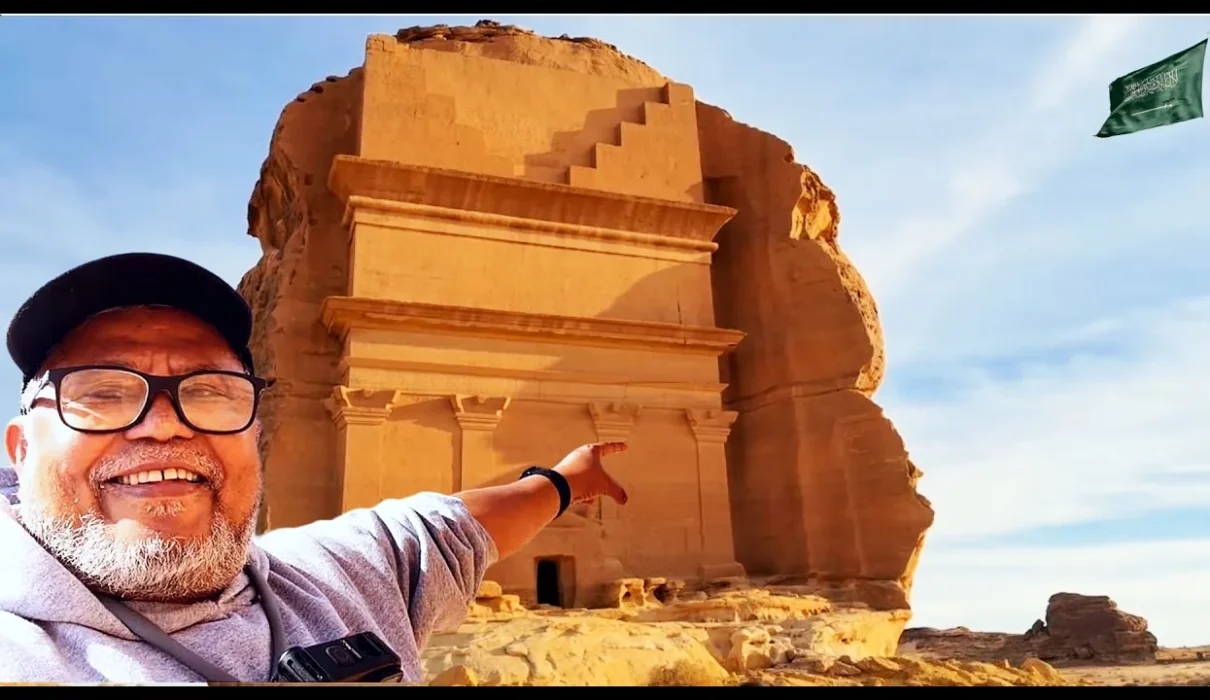
If there is one monument that has become synonymous with Mada’in Saleh, it is Qasr al-Farid.
Often translated as “The Lonely Castle,” this enormous tomb stands apart from many of the other monuments. Its isolated position makes it one of the most recognizable sights in Saudi Arabia.
The façade was carved directly into a massive sandstone outcrop, creating an imposing structure that seems almost too large to have been made by hand.
One of its most intriguing characteristics is that the monument appears unfinished. Parts of the rock around the lower section remain uncarved, offering visitors an unusual glimpse into the process behind Nabataean rock-cut architecture.
Rather than making the monument less impressive, its unfinished appearance makes it even more fascinating. It raises questions about how ancient craftsmen planned their work, how they shaped the stone, and why construction may have stopped.
Jabal al-Banat and the Tombs of the Elite
Another major area of Hegra is Jabal al-Banat, meaning “Mountain of the Daughters.”
This section contains a remarkable concentration of monumental tomb façades. The scale and decoration of these structures demonstrate that burial architecture was an important expression of status and wealth within Nabataean society.
The tombs and their inscriptions also provide clues about the individuals and families connected to them.
For modern visitors, Jabal al-Banat is a reminder that Hegra wasn’t simply a collection of impressive buildings. It was once a functioning community where families lived, worked, worshipped, traded, and eventually buried their dead.
Jabal al-Ahmar: A Closer Look at Nabataean Tombs
Known as the Red Mountain, Jabal al-Ahmar offers another perspective on the archaeological richness of Hegra.
Several tombs are carved into the reddish sandstone, and inscriptions preserved on the rocks provide valuable evidence about Nabataean society and burial customs.
These details can easily be overlooked when standing in front of a huge monument. But the inscriptions are among the most valuable elements of the site because they connect the architecture to real people and historical events.
They help transform Hegra from a beautiful collection of ancient façades into a place with individual stories.
More Than Just Another Archaeological Site
There are many ancient ruins around the world, but Hegra has a distinctive atmosphere.
Part of that comes from its enormous scale. Another part comes from the desert environment. Most importantly, however, it is the contrast between the ancient carvings and the surrounding emptiness that makes the site feel so different.
The Nabataeans worked directly with the landscape rather than simply building on top of it. Mountains and rock formations became tombs, ceremonial spaces, and landmarks.
That relationship between architecture and nature is one of the strongest reasons to visit.
Is the 1,000 km Drive Worth It?
For someone traveling specifically to see Hegra, the distance is a serious consideration.
A journey of around 1,000 kilometers requires commitment. If you are expecting a quick attraction that can be explored in an hour and forgotten, the drive may feel excessive.
But if you enjoy history, ancient civilizations, architecture, photography, road trips, and unusual landscapes, the destination offers something genuinely special.
The experience is not only about reaching one famous monument. It is about gradually moving into the AlUla landscape and discovering an archaeological environment where ancient history remains visible in the rocks.
And then there is the moment when Qasr al-Farid finally appears in front of you.
For many travelers, that alone can make the long road feel justified.
What Makes Hegra Historically Important?
Hegra is significant not just because of its beautiful tombs but because it provides evidence of the Nabataean civilization in the Arabian Peninsula.
Its location illustrates the importance of ancient trade networks, while its architecture reveals the technical and artistic abilities of the people who lived here.
The inscriptions, tombs, ceremonial spaces, and surrounding settlement remains together provide a broader picture of Nabataean culture.
In 2008, UNESCO inscribed Al-Hijr Archaeological Site (Mada’in Salih) on the World Heritage List, making it Saudi Arabia’s first World Heritage property.
That recognition reflects the site’s exceptional archaeological and historical value.
Hegra Today: Ancient History in a Changing Saudi Arabia
Saudi Arabia has been opening more of its cultural and archaeological heritage to international visitors, and AlUla has become one of the country’s most prominent destinations.
Hegra sits at the center of that story.
The area demonstrates that Saudi Arabia’s history stretches far beyond the modern era and includes sophisticated civilizations that participated in international trade and developed their own distinctive architectural traditions.
For visitors, the attraction is therefore both ancient and contemporary: you are exploring a civilization that flourished thousands of years ago while witnessing a region that is becoming an increasingly important destination for cultural tourism.
Final Verdict
So, was Mada’in Saleh worth a 1,000 km drive?
If ancient history, dramatic landscapes, and road-trip adventures are your kind of travel, the answer is likely yes.
Hegra isn’t a destination that can be fully appreciated through a few photographs. The scale of the sandstone formations, the silence of the desert, and the sight of monumental tombs carved into natural rock are experiences that become much more powerful when witnessed in person.
The journey may be long, but that’s also part of the adventure.
After spending hours on the road, arriving among the ancient Nabataean monuments creates a remarkable feeling: you have traveled a very long distance in the present to encounter a world that existed thousands of years ago.
And perhaps that is what makes Mada’in Saleh so memorable.
The road is long. The history is even longer. And for the right traveler, Hegra is absolutely worth the journey.